2026 Proxy Season Highlights: Final Shareholder Proposal Results and Management Proposals
Despite uncertainty heading into the 2026 proxy season (January 1 – June 30 meetings), final voting results largely continued established patterns. Governance proposals attracted the strongest support, while environmental and social (E&S) proposals and proposals from anti-environmental, social and governance (ESG) proponents received considerably less support. Director elections and say-on-pay proposals continued to receive strong shareholder support, and ISS recommendations were again associated with sharp differences in voting outcomes across shareholder and management proposals.
Building on our early review of the 2026 shareholder proposal season, this alert reviews final 2026 shareholder proposal voting results across the Russell 3000, with separate analyses of tech companies, life sciences companies and, for the first time, “recently public companies,” defined as Russell 3000 companies that went public since 2016. This additional lens complements Cooley’s inaugural Post-IPO Governance Trends Report, which examines how governance practices and annual meeting voting outcomes evolve during companies’ early years as public companies. We also highlight key trends in director elections and say-on-pay votes across each of these groups, and we review voting results for select nonroutine management proposals across the Russell 3000.
This alert precedes the SEC’s expected September proposal to rescind Rule 14a-8. This proposal is currently under review by the White House, and Cooley’s June alert includes a discussion of how such a proposal may impact the 2027 proxy season.
Shareholder proposals
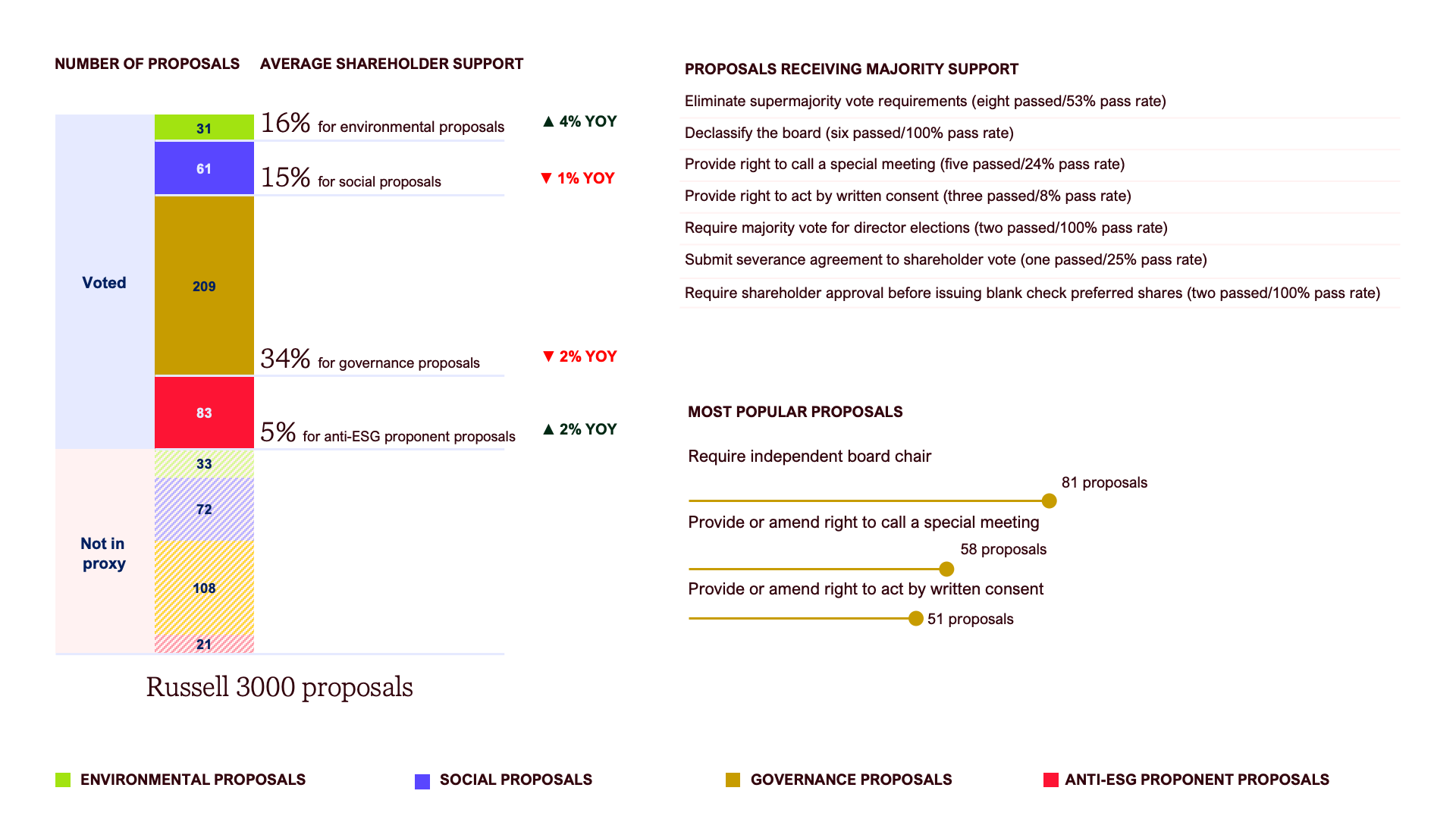
Although the SEC staff’s withdrawal from its traditional role in the Rule 14a-8 no-action process created substantial uncertainty, 2026 voting results largely followed recent patterns. Governance proposals remained the best-supported category, averaging 34% support, compared with 16% for environmental proposals, 15% for social proposals and 5% for proposals from anti-ESG proponents. The results reinforce a familiar divide: proposals addressing core governance and shareholder rights matters continue to attract materially more investor support than E&S proposals. Looking ahead, the forthcoming SEC proposal to rescind Rule 14a-8 and the SEC staff’s recent decision to end no-action responses entirely could produce more significant change in 2027, including more aggressive efforts by proponents to challenge exclusions or other actions to preserve access to companies’ proxy materials.
2026 shareholder proposals at Russell 3000 companies
ISS recommendations and shareholder support
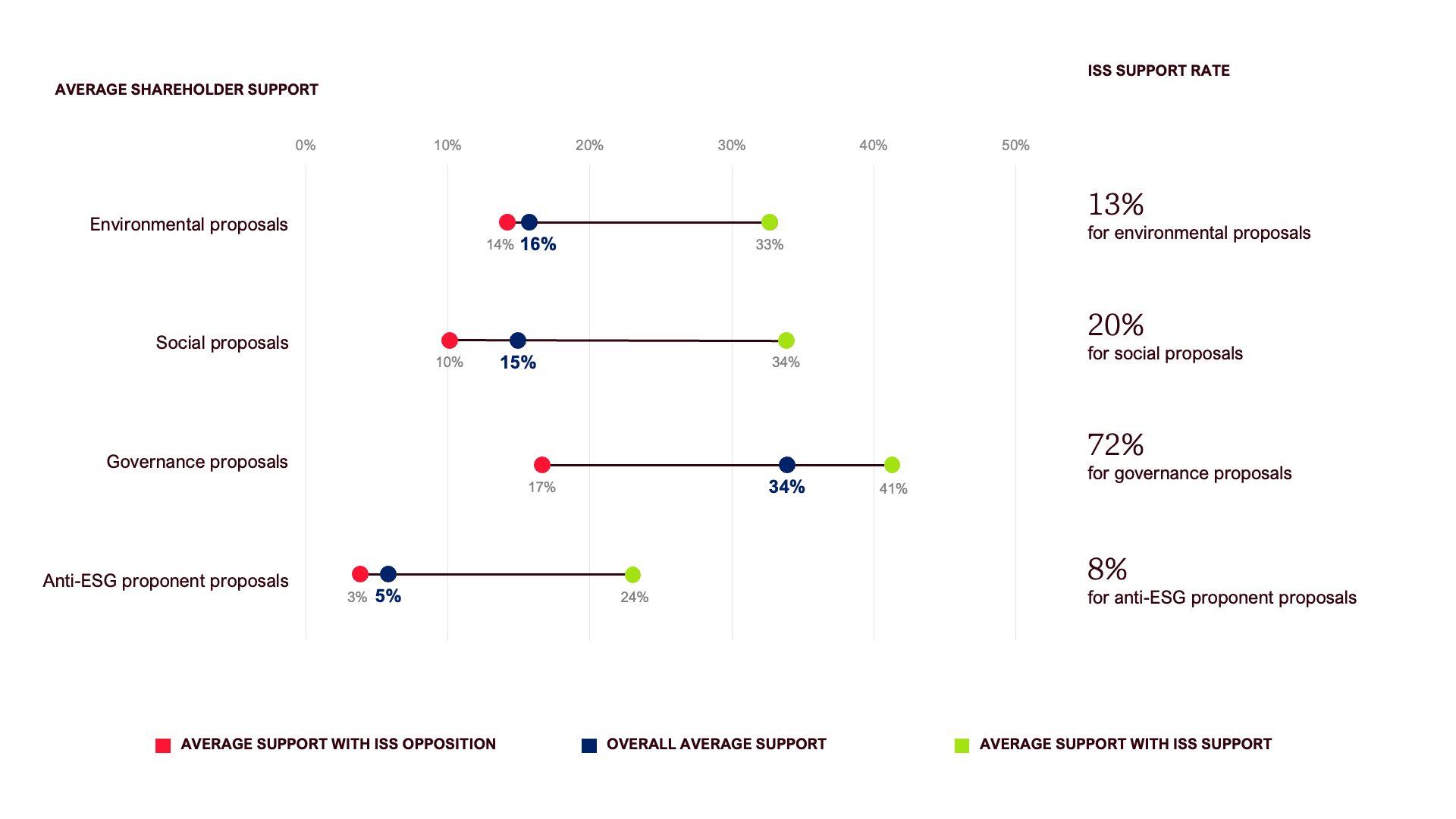
ISS recommendations were closely associated with voting outcomes across every proposal category. Across all Russell 3000 companies, proposals backed by ISS averaged 33% support for environmental matters, 34% for social matters, 41% for governance matters and 24% for proposals from anti-ESG proponents, compared with 14%, 10%, 17% and 3%, respectively, when ISS opposed them. Although these results reflect correlation rather than causation, they underscore the continuing importance of proxy advisor recommendations to voting outcomes.
Average shareholder support varied sharply with ISS recommendations
Sector trends
Tech companies
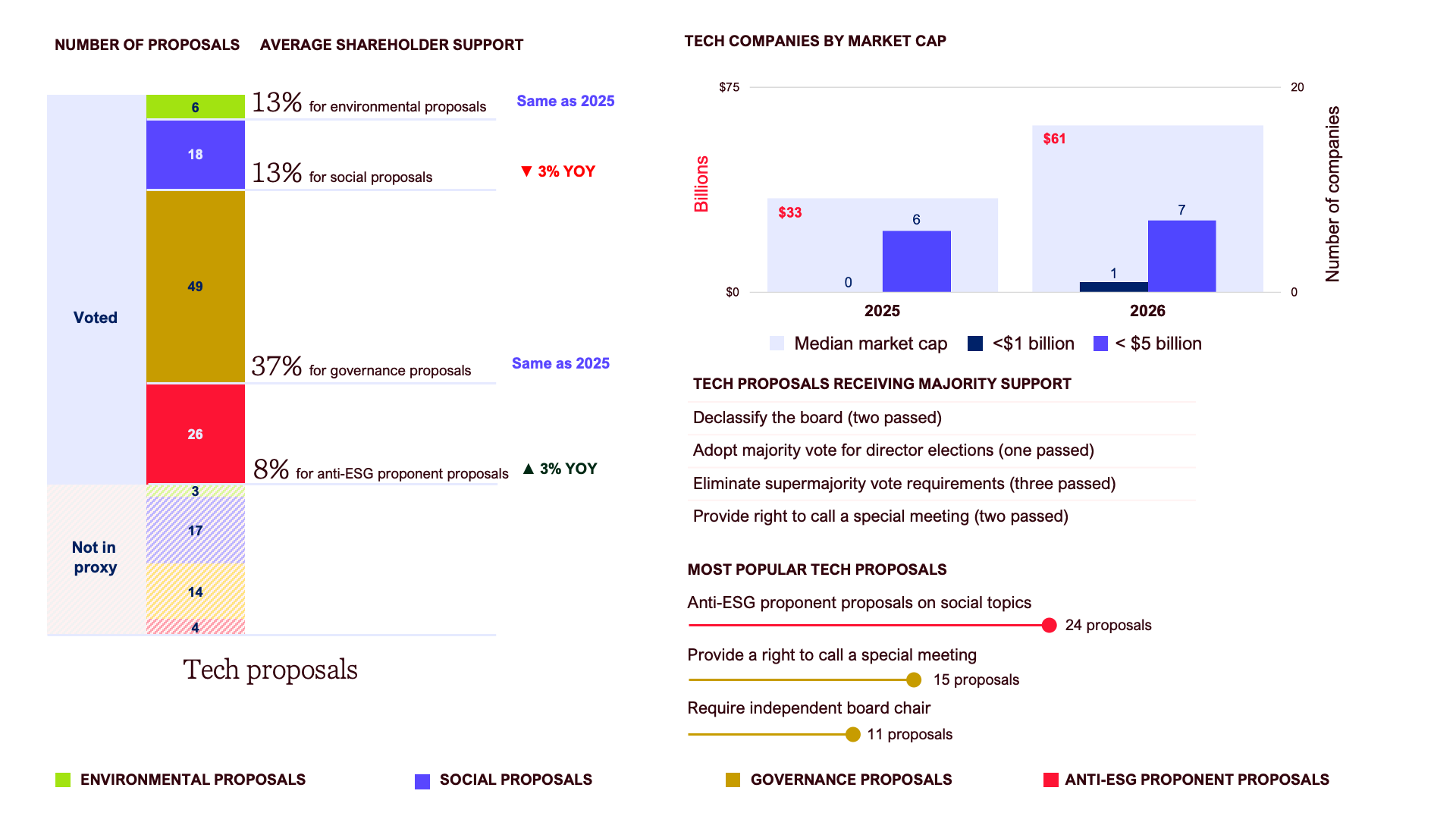
Governance proposals at tech companies substantially outperformed other proposal categories, averaging 37% support compared with 13% for both environmental and social proposals. Proposal activity also remained concentrated among large-cap tech companies, with recipients having a median market capitalization of $61 billion.
Tech companies continued to be the primary target of anti-ESG proponents, accounting for 28% of their proposal submissions in 2026. Most of these proposals focused on social topics, with diversity, equity and inclusion (DEI), viewpoint and ideological discrimination, AI and data privacy representing the most common topics. Consistent with the broader market, shareholder support for social-focused proposals submitted by anti-ESG proponents at tech companies remained low in 2026, averaging 2%.
2026 shareholder proposals at tech companies
Life sciences companies
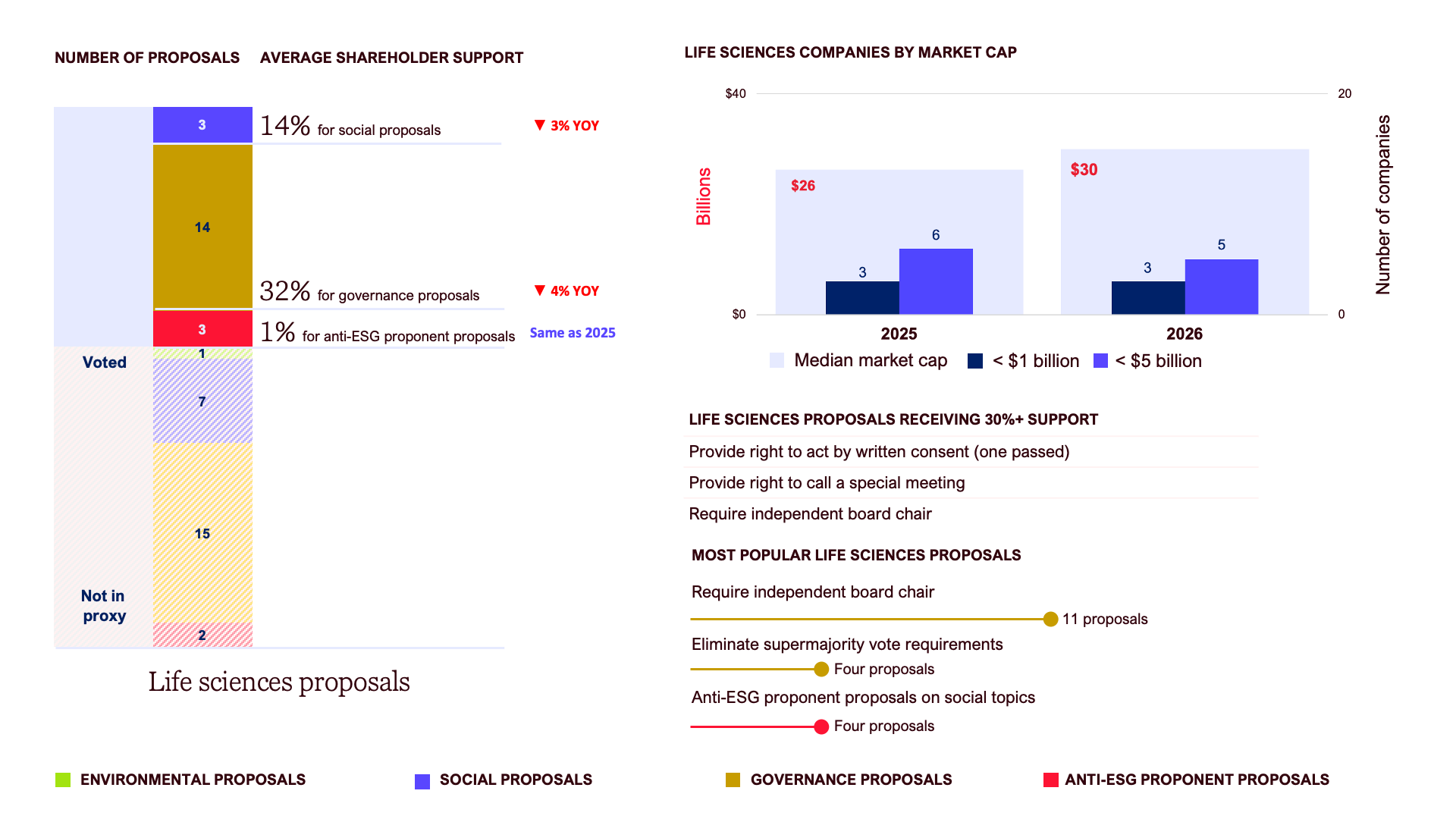
While shareholder proposal activity remained relatively limited at life sciences companies, voting outcomes were generally consistent with broader market trends. Governance proposals averaged 32% support, compared with 14% for social proposals and 1% for proposals from anti-ESG proponents, and no environmental proposal went to a vote. Proposal activity also remained concentrated among large-cap life sciences companies, with recipients having a median market capitalization of $30 billion.
2026 shareholder proposals at life sciences companies
Recently public company trends
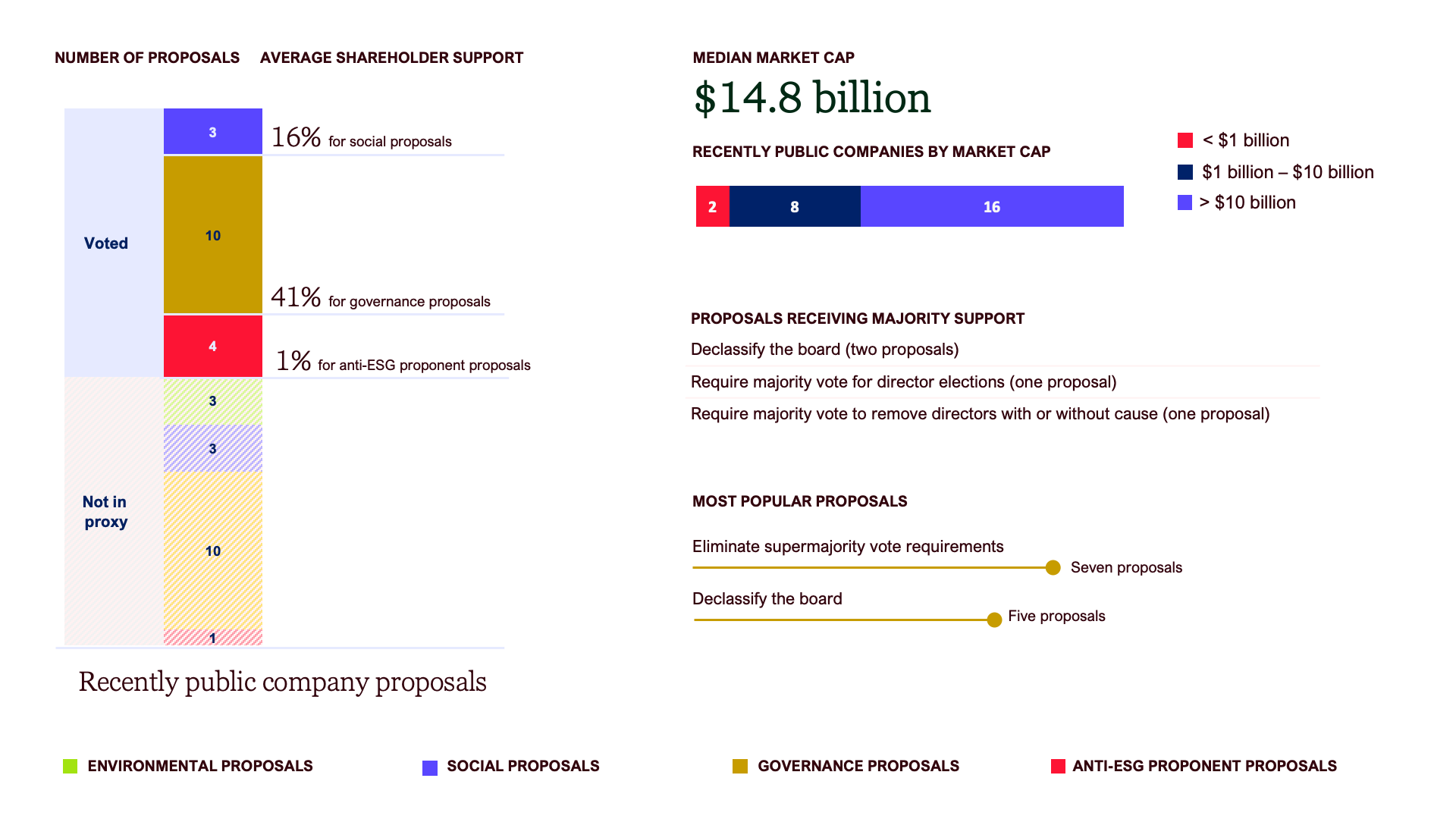
Among Russell 3000 companies that went public since 2016, shareholder proposal activity was relatively limited and skewed toward larger companies. We identified 34 publicized proposals – representing less than 6% of total publicized submissions – and the median market capitalization of recently public companies receiving proposals was $14.8 billion. Of the 26 recipient companies, 16 had market capitalizations above $10 billion, and none went public after 2021. Where proposals did reach recently public companies, governance issues dominated. Each of the four proposals receiving majority support addressed a foundational governance matter: two sought board declassification, one sought majority voting for director elections and one sought majority voting for director removal. These results are consistent with a broader post-IPO pattern: As companies mature and their ownership bases broaden, IPO-era governance structures attract increasing shareholder scrutiny.
2026 shareholder proposals at recently public companies
Management proposals
Director elections
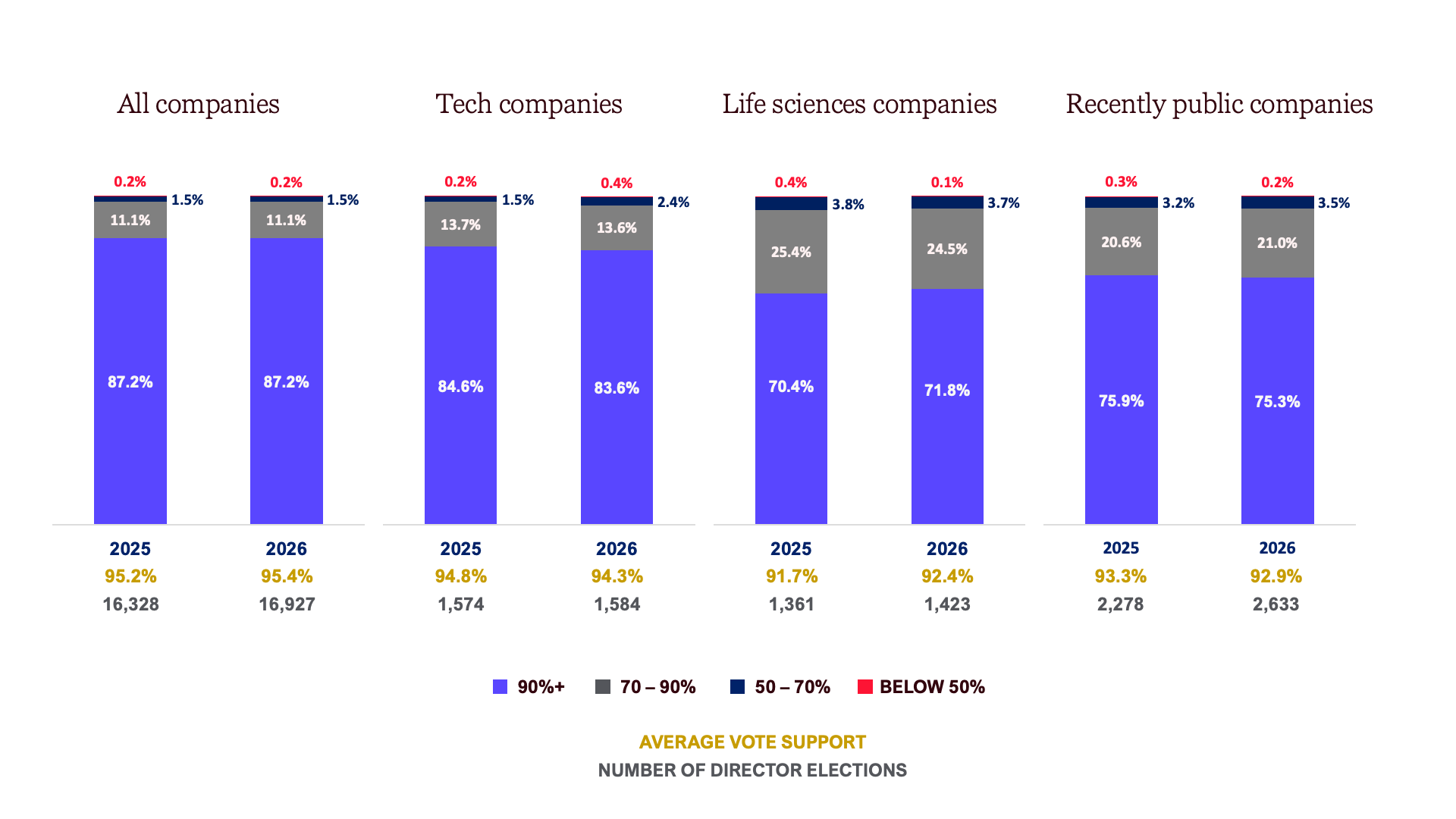
Director election results remained strong in 2026. Average support was 95.4% across Russell 3000 companies, compared with 94.3% at tech companies, 92.4% at life sciences companies and 92.9% at recently public companies. Similarly, 87.2% of all Russell 3000 director nominees received more than 90% support, compared to 83.6%, 71.8% and 75.3% of director nominees at tech, life sciences and recently public companies, respectively.
Director election vote results by support level
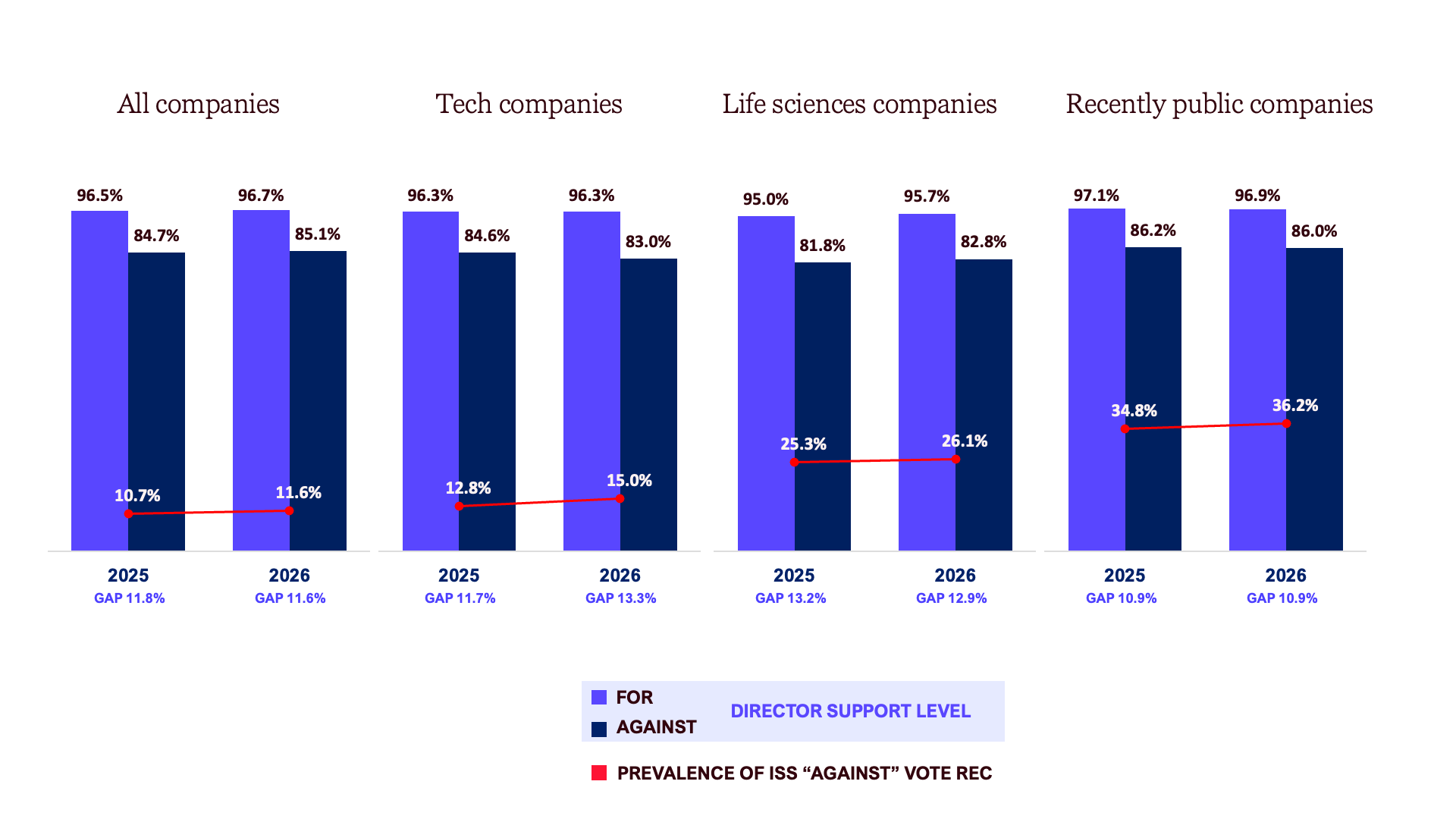
ISS opposition continued to correlate meaningfully with voting outcomes across all companies, although its incidence varied significantly by group. ISS recommended against 11.6% of all Russell 3000 director nominees, compared with 15% at tech companies, 26.1% at life sciences companies and 36.2% at recently public companies. Despite receiving the highest opposition rate, director nominees at recently public companies averaged nearly 93% support. As discussed in our Post-IPO Governance Trends Report, proxy advisors frequently oppose directors at newly public companies because of governance provisions commonly adopted at the time of IPO, but these recommendations generally have a more limited impact on voting outcomes, likely reflecting concentrated ownership and greater investor tolerance for these governance structures during the early post-IPO period, particularly among large institutional investors that often afford newly public companies more time to evolve their governance practices.
Variance in director election support levels by ISS recommendation
Say-on-pay
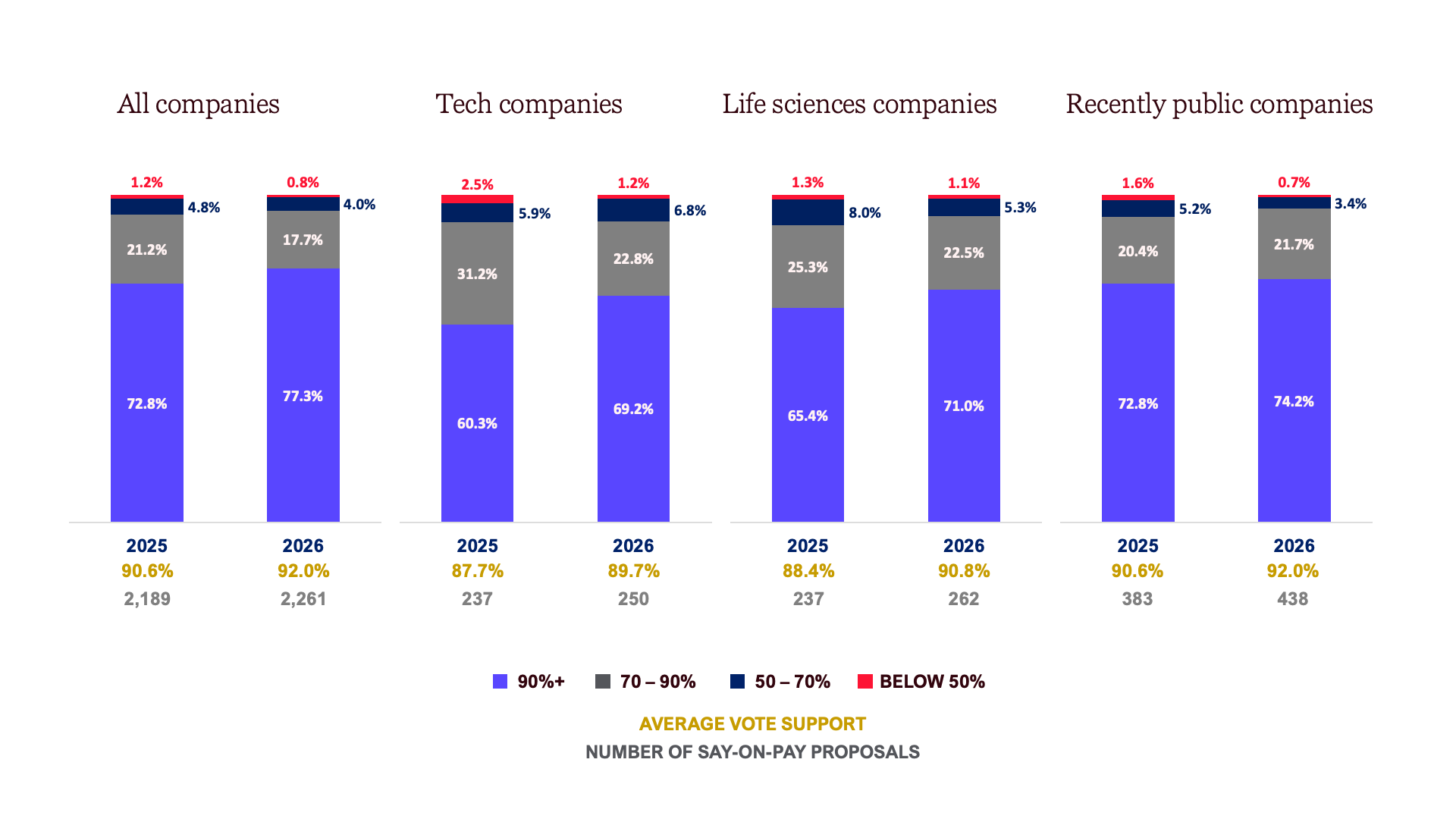
Say-on-pay results also remained strong, with average support of 92% across the Russell 3000, 89.7% at tech companies, 90.8% at life sciences companies and 92% at recently public companies. Each group saw year-over-year increases in average support and in the percentage of proposals receiving more than 90% support.
Say-on-pay vote results by support level
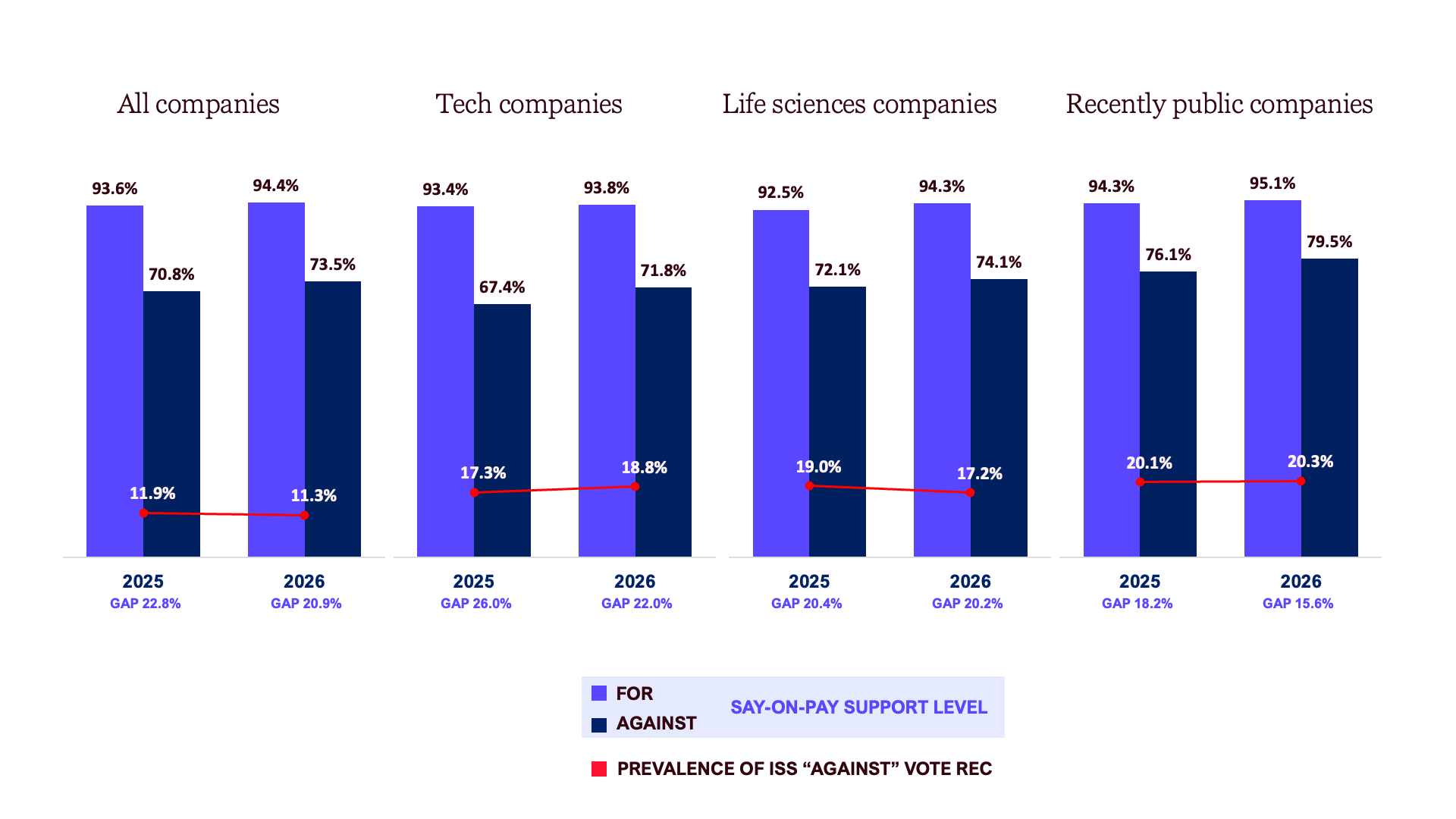
ISS recommendations were again closely associated with say-on-pay voting results. Across the Russell 3000, ISS-supported proposals averaged 94.4% support, compared with 73.5% for ISS-opposed proposals. The gap was widest among tech companies at 22 percentage points, though this gap was down from 26 points in 2025. Recently public companies had a higher rate of ISS opposition than the broader Russell 3000, but adverse recommendations had a smaller effect on their voting outcomes. As with director elections, this likely reflects concentrated ownership and greater investor patience during the early post-IPO period, particularly among large institutional investors that often afford newly public companies more time to mature their compensation practices.
Variance in say-on-pay support levels by ISS recommendation
Select nonroutine management proposals
Responsive governance proposals
Management proposals seeking to unwind long-standing governance provisions declined in 2026. Board declassification proposals declined from 44 in 2025 to 31 in 2026, while proposals to eliminate supermajority vote requirements fell from 70 to 47. The decline likely reflects market maturation rather than diminished focus on these core governance issues, as many larger-cap, consumer-facing companies that historically faced the greatest investor pressure to eliminate these structures have already done so.
Shareholder support remained relatively steady, averaging 79% for declassification proposals and 77% for supermajority-elimination proposals, compared with 80% for both proposal types in 2025. However, passage rates notably declined, from 75% to 68% for declassification proposals and from 70% to 57% for supermajority-elimination proposals. The lower passage rates appear to reflect stringent charter or bylaw amendment thresholds rather than declining shareholder support. Many such amendments require approval by a supermajority of outstanding shares, and in each of 2025 and 2026, only one proposal to eliminate a supermajority vote requirement failed to receive support from a majority of outstanding shares.
DExit reincorporation proposals
Nevada and Texas remained the primary destinations for companies seeking to leave Delaware, with Texas emerging as the top destination in 2026. Nevada attracted four Delaware exit (DExit) proposals in 2024 and eight in 2025, but only three in 2026, while Texas increased from one proposal in 2024 and none in 2025 to 10 in 2026.
Notably, nearly 70% of the 26 companies that have sought shareholder approval to reincorporate from Delaware to Nevada or Texas since 2024 had a controlling shareholder or a significant insider voting bloc. This trend is consistent with the role that controlling shareholder concerns have played in driving the broader DExit movement.
Although 88% of DExit proposals have passed, this high success rate appears to reflect concentrated insider ownership at many of the companies pursuing these reincorporations rather than broad investor support. Assuming insiders voted all of their shares in favor, estimated noninsider support averaged 43% across all DExit proposals, including 30% at controlled companies and 55% at noncontrolled companies. This disparity suggests that institutional investors are generally more skeptical of DExit proposals at controlled companies.
Support from the Big Three – BlackRock, Vanguard and State Street – for DExit proposals has also been limited. While all three firms supported Tesla’s 2024 move to Texas, among Nevada reincorporation proposals in 2024 and 2025, BlackRock, Vanguard and State Street supported only 25%, 17% and 0%, respectively. Voting data for institutional investors on 2026 reincorporation proposals will become available in September 2026.
Officer exculpation proposals
Among Delaware-incorporated Russell 3000 companies, officer exculpation proposals continued to decline in prevalence following the initial wave of proposals after Delaware authorized officer exculpation in 2022. Proposal volume fell from 115 in 2025 to 53 in 2026, average support declined from 72% to 66% and the passage rate decreased from 93% to 87%. The decline occurred despite a modest increase in ISS support, as the percentage of proposals receiving favorable ISS recommendations rose from 84% in 2025 to 87% in 2026. Nevertheless, officer exculpation proposals continued to pass at a high rate.
Notes
- The data presented in this alert are sourced from ISS Voting Analytics, as well as other databases, information publicized by shareholder proposal proponents and companies, and independent research, and focus exclusively on Russell 3000 companies.
- For purposes of shareholder proposals discussed in this alert, “tech” includes core hardware, software and computing companies, as well as web-focused businesses in retail, transportation, business services and other industries, such as ride share, ecommerce and fintech companies, to approximate the commonly understood scope of the tech sector. Due to the volume of management proposals, discussion of management proposals in this alert involves a more restrictive definition of tech, focusing on companies classified under Global Industry Classification Standard (GICS) codes 4510 (Software & Services), 4520 (Technology Hardware & Equipment) and 4530 (Semiconductors & Semiconductor Equipment).
- For purposes of all proposals discussed in this alert, “life sciences” refers to companies classified under GICS code 3520 (Pharmaceuticals, Biotechnology & Life Sciences).
- For purposes of all proposals discussed in this alert, “recently public companies” refers to public companies that went public since 2016.
2026 proxy season at a glance
Explore the key trends, proposal outcomes and shareholder voting results from the 2026 proxy season in our visual snapshot.
Related Contacts


This content is provided for general informational purposes only, and your access or use of the content does not create an attorney-client relationship between you or your organization and Cooley LLP, Cooley (UK) LLP, or any other affiliated practice or entity (collectively referred to as "Cooley"). By accessing this content, you agree that the information provided does not constitute legal or other professional advice. This content is not a substitute for obtaining legal advice from a qualified attorney licensed in your jurisdiction, and you should not act or refrain from acting based on this content. This content may be changed without notice. It is not guaranteed to be complete, correct or up to date, and it may not reflect the most current legal developments. Prior results do not guarantee a similar outcome. Do not send any confidential information to Cooley, as we do not have any duty to keep any information you provide to us confidential. When advising companies, our attorney-client relationship is with the company, not with any individual. This content may have been generated with the assistance of artificial intelligence (Al) in accordance with our Al Principles, may be considered Attorney Advertising and is subject to our legal notices.