Structuring CVC-Backed Funds: A Governance, Economics and Regulatory Deep Dive
Introduction
This article is the second in our series on fund structures for corporate venture capital (CVC) sponsors. The first article in the series examined the principal models through which a corporate sponsor can collaborate with a fund manager (FM) at the general partner (GP) level. This article builds on that analysis by examining the governance architecture of each approach in greater depth, specifically the allocation of control, economics, liability and regulatory exposure between the corporate sponsor and the FM. These dimensions are among the most consequential and contested aspects of any CVC fund structuring exercise.
The four structures examined in this second article are presented broadly in order of increasing governance depth, though the co-GP structure (structure 4) represents the most extensive form of engagement. In practice, negotiated arrangements often combine elements from more than one structure to achieve a bespoke balance that reflects the relative bargaining positions and strategic objectives of the parties.
The four structures are:
- Minority equity stake and board representation in the GP entity
- Investment committee representation
- Contractual rights arrangements
- Dual/parallel co-GP structure
Each structure is discussed in turn below, with analysis of its key commercial terms and the principal advantages and disadvantages from both the CVC’s and FM’s perspectives.
1. Minority equity stake and board representation in the GP entity
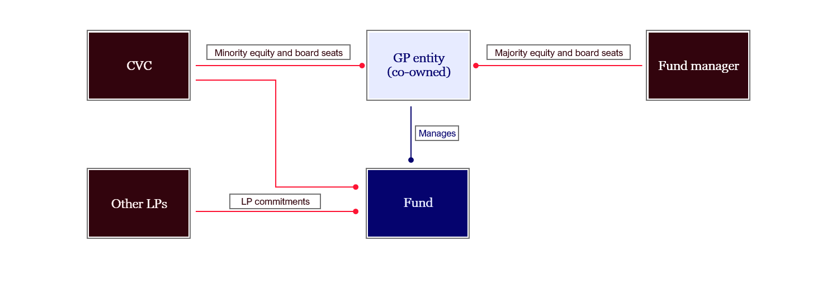
Under this structure, the CVC acquires a minority equity interest in the GP entity, with the FM retaining majority ownership and control. The equity stake is typically accompanied by minority representation on the GP’s board of directors, together with a package of protective rights designed to embed the CVC’s governance position durably within the constitutional framework of the GP entity itself.
Key commercial terms
The CVC holds minority equity in the GP, with the FM retaining majority equity and corresponding majority board representation. The CVC receives a pro rata share of management fees and carried interest in proportion to its GP equity stake. Protective provisions in the GP’s constitutional documents confer veto rights over defined categories of major decisions, including amendments to the limited partnership agreement (LPA) or other fund documents, hiring or termination of key persons, related party transactions, changes to the fee or carry structure, new GP equity issuances or a change of control of the GP, fund dissolution, and material or conflicted investment decisions.
The CVC’s equity position is further protected by the following provisions:
- Preemption rights, a right of first refusal and tagalong rights on any transfer of GP equity by the FM.
- Anti-dilution protections against future issuances.
- Key person provisions addressing the consequences of FM principal departures.
- Noncompete obligations typically imposed on the CVC parent in respect of specified fund verticals.
- Deadlock resolution mechanisms (customarily a put/call arrangement or a buy-sell “shotgun” mechanism) to address irreconcilable disagreements between the parties.
CVC’s perspective
From the CVC’s perspective, the principal advantages are economic and constitutional. The board seat is embedded within the GP entity’s constitutional framework, making it the most durable form of governance influence across all four structures. It also provides direct board-level visibility into fund strategy and portfolio management. The pro rata participation in management fees and carried interest delivers a direct share of the fund’s economics. Tagalong rights and the right of first refusal protect the CVC’s ability to exit the GP equity stake on the same terms as the FM. The CVC’s own regulatory position is expected to remain outside the scope of registration requirements under the Investment Advisers Act of 1940 (Advisers Act). Note that this analysis reflects the US regulatory position; other jurisdictions may impose different registration, licensing or regulatory requirements on a CVC that acquires a minority equity interest in a GP entity, and local counsel advice should be sought.
The disadvantages are significant. By acquiring GP equity, the CVC assumes Advisers Act fiduciary duties owed to all fund limited partners (LPs), creating a substantially heavier governance burden than arises under the lighter-touch structures examined below. Affiliated transactions between the CVC parent and the fund give rise to potential conflicts of interest and, in some cases, principal transaction concerns. GP entity valuation at entry and at any subsequent exit is complex and frequently contentious. If the fund underperforms, disputes over carried interest or fee dilution may arise between the CVC and the FM.
FM’s perspective
From the FM’s perspective, the CVC’s equity commitment provides institutional validation and working capital for the GP entity. The buy-sell mechanism affords the FM a defined exit pathway from the CVC relationship should the parties’ interests diverge. The CVC’s commercial network and strategic resources are formally committed to the fund through the equity relationship, creating obligations that informal arrangements would not.
The downsides for the FM are also material. The loss of sole control over the GP entity and the dilution of carry and fee economics are significant concessions. The FM must manage a minority shareholder relationship alongside a diverse LP base, adding governance complexity. There is a real risk that the FM is not perceived as an independent and disinterested fiduciary for the capital contributed by other LPs, particularly where the CVC parent has interests in portfolio companies or co-investment opportunities. Veto rights create operational friction and can delay time-sensitive investment decisions. The obligation to disclose the CVC’s preferential treatment may invite most-favored-nation (MFN) claims from existing and prospective LPs. Further, if the CVC parent undergoes a change of control, this will likely destabilize the fund.
2. Investment committee representation
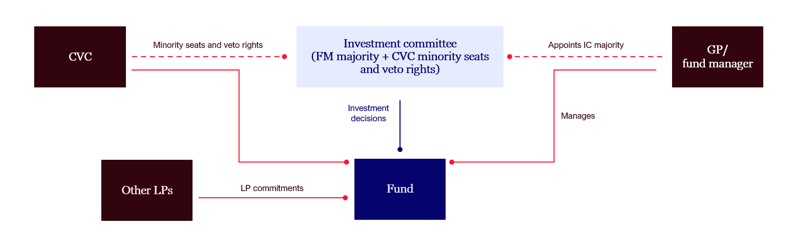
Under this structure, the CVC holds minority seats on the fund’s investment committee (IC) without acquiring any equity interest in the GP entity. The FM retains full GP ownership and control, as well as majority representation on the IC. The CVC’s influence over investment decisions is exercised through defined veto rights that attach to specified categories of investment decision.
Key commercial terms
The CVC appoints minority IC members, who may sit as voting members or as nonvoting observers depending on the terms negotiated. IC quorum requirements typically mandate the presence of at least one CVC representative (or a waiver) before a quorum is constituted. CVC veto rights are limited to defined categories of decision, typically including investments above a specified percentage of fund size, investments in sectors competitive with the CVC parent, follow-on investments above agreed concentration limits, below-cost or related-party exit decisions, and co-investment allocation decisions.
Mandatory recusal protocols address decisions in which the CVC parent has a conflict of interest. Strict nondisclosure obligations and information barriers between CVC IC members and the CVC parent are essential features to prevent confidential deal intelligence from migrating from the CVC's IC representatives to the CVC parent. IC appointees are removable for cause, and any replacement is subject to the FM’s reasonable consent. A fundamental drafting question concerns whether CVC IC members vote in their personal capacity or as agents of the CVC entity. If acting as agents, knowledge acquired by IC representatives may be attributed to the CVC entity directly, broadening potential liability exposure and complicating conflict management. Conversely, if acting in a personal capacity, the CVC entity has less formal control over how its nominees exercise their votes, and the enforceability of IC voting instructions may be limited. The answer to this question also affects how confidential information obligations are structured and whether the CVC entity is treated as an “insider” for purposes of the fund’s securities law compliance framework.
CVC’s perspective
From the CVC’s perspective, this structure affords operational influence over investment decisions without the burden of GP equity ownership. Early visibility into proprietary deal flow in sectors of strategic relevance to the CVC parent is a significant benefit. The regulatory footprint is considerably lighter than under structure 1, and exit from the arrangement is simpler. There is no GP equity interest to unwind. There is, however, a reputational risk to the CVC if its IC representatives are perceived to have blocked or delayed deals for reasons that serve the CVC parent’s interests rather than those of the fund. The parties may also negotiate a separate carry arrangement, under which IC representation is accompanied by a defined economic participation in fund profits, though this is structurally distinct from the fee and carry entitlements that flow from GP equity ownership itself.
The disadvantages are nevertheless meaningful. CVC IC representatives may be treated as access persons of the investment adviser, with consequent compliance and information-handling obligations. Conflict recusal protocols are operationally complex, and contested recusals create friction with the FM and other LPs. The CVC’s veto rights may need to be disclosed to other LPs, and the limited partner advisory committee (LPAC) may object to the conferral of governance influence on a single LP. Confidential deal intelligence is necessarily exposed to the CVC’s IC representatives, creating a risk that commercially sensitive information migrates to the CVC parent notwithstanding information barriers.
FM’s perspective
From the FM’s perspective, this structure preserves full GP equity ownership and economics without dilution of carry or fee entitlements. The CVC’s veto rights are limited to defined categories of decision, with the FM retaining majority control of the IC. IC rights can be structured to sunset at the end of the investment period, limiting the duration of the CVC’s governance influence.
The drawbacks are also significant. The CVC’s veto may delay or block time-sensitive investment decisions. Confidential deal flow and portfolio data are necessarily exposed to a corporate LP whose parent may compete with portfolio companies, and intelligence may migrate inadvertently to the CVC parent despite information barriers. Other LPs may invoke MFN provisions to demand equivalent observation rights. Deadlock mechanics are required but often contentious to negotiate.
3. Contractual rights arrangements
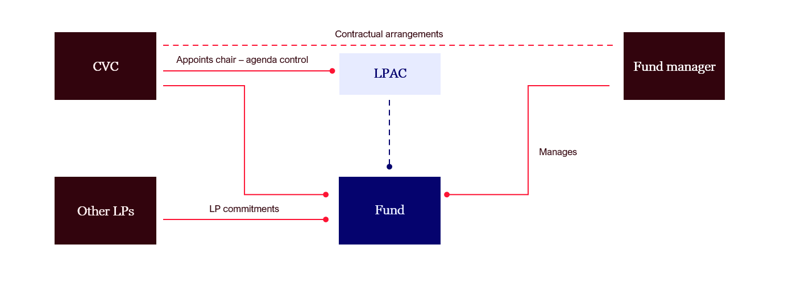
Under this structure, the CVC and the FM enter into a suite of stand-alone contractual arrangements that confer defined management-adjacent rights on the CVC, without any equity stake in the GP or formal seat on any governance body. This is the lightest-touch governance structure of the four and affords the greatest flexibility to both parties.
Key commercial terms
The contractual arrangements typically comprise some or all of the following elements:
- Co-investment rights. A right for the CVC (or its parent) to participate alongside the fund in portfolio investments on a pro rata or fixed-allocation basis, on no-fee, no-carry or preferential terms.
- Deal sourcing exclusivity window. A contractual obligation on the FM to present defined categories of investment opportunity to the fund (rather than to competing vehicles) for a specified period before the FM may pursue them elsewhere.
- Enhanced information rights. Reporting rights beyond those available to ordinary LPs, including access to deal pipeline data, portfolio company information and IC materials relevant to the CVC parent’s sectors of strategic interest.
- Portfolio assistance framework. A services or secondment arrangement under which the CVC parent provides defined resources – commercial, technical or operational – to portfolio companies, typically on arm’s-length terms.
- Advisory or observer rights. A right for the CVC to appoint a nonvoting observer to the IC or the GP’s board, without any veto or quorum right, to preserve visibility into fund governance without triggering the regulatory or fiduciary consequences of formal membership.
CVC’s perspective
From the CVC’s perspective, this structure carries the lightest regulatory footprint of the four; the CVC’s rights are purely contractual and do not give rise to regulatory obligations associated with GP or IC status. Each right can be negotiated, transferred or terminated independently of the others, providing maximum flexibility as the CVC-FM relationship evolves. In many cases, co-investment rights can deliver more direct and immediate financial value than a GP equity stake. The portfolio assistance framework directly serves the CVC parent’s corporate development agenda without requiring formal governance involvement.
The disadvantages lie principally in enforcement. Contractual rights are inherently weaker than constitutionally embedded rights. The remedy for breach is limited to damages or specific performance, neither of which may provide timely protection in a fast-moving investment context. The deal sourcing exclusivity window can constrain the pace of both the fund and the CVC parent. All rights must be carefully drafted to survive any assignment of the management agreement. A CVC that exercises its contractual rights with sufficient regularity and depth risks being characterized as a de facto fund manager, with associated liability consequences.
FM’s perspective
From the FM’s perspective, this structure is the least disruptive to its ownership, control and economics. Full GP ownership is retained, and the flexibility of independent contractual arrangements allows each right to be negotiated, modified or terminated without affecting the others. The structure has no impact on the FM’s regulatory profile or compliance obligations. The strategic advisory relationship can enhance the LP value proposition at low governance cost to the FM.
The principal downsides for the FM relate to the ripple effects on its other LP relationships. Co-investment terms and enhanced information rights will frequently trigger MFN demands from other LPs. The deal sourcing exclusivity window can constrain the pace of deal execution for the fund as a whole. Multiple separate agreements create operational complexity and a risk of inconsistency between documents. Portfolio assistance arrangements must be structured on strictly arm’s-length terms to avoid self-dealing claims from other LPs.
4. Dual/parallel co-GP structure
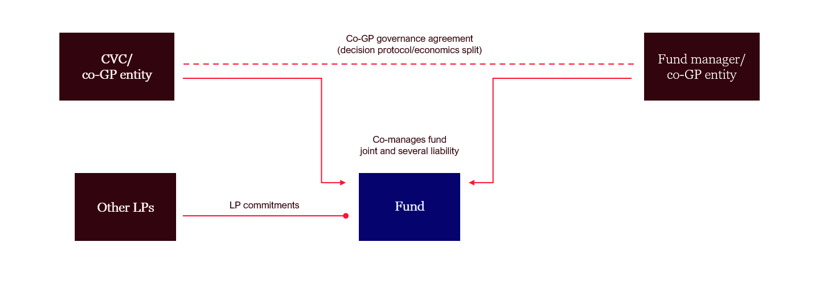
The co-GP structure is the most ambitious and operationally complex of the four. Unlike the joint venture model examined in our first article (model 3), which involves shared equity ownership of a single GP entity by the corporate sponsor and an industry partner, this structure involves two separate legal entities, the FM’s own GP and a newly established CVC co-GP entity, each named as a GP of the fund in the LPA. Both co-GPs bear joint and several liability to the fund’s LPs, and share in the economics of the GP according to an agreed formula. The governance, liability and regulatory issues specific to dual co-GP structures, including inter-GP coordination, separate regulatory obligations and fund continuation mechanics, are examined in detail below.
Key commercial terms
Both entities are named as co-GPs in the LPA, with management fees and carry allocated between them in accordance with an agreed formula. A co-GP governance agreement sets out with precision the matters that require unanimous consent and those that can be decided by either a co-GP or majority. Unanimous consent matters typically include amendments to the LPA or other fund documents, changes to investment strategy or mandate, investment decisions above a defined threshold, key person appointments and terminations at either co-GP, related party transactions, dissolution of the fund or either GP entity, any assignment of GP rights or management economics, and material changes to compliance or regulatory frameworks.
While both co-GPs are jointly and severally liable to LPs under the LPA, an internal indemnification agreement allocates liability between the co-GPs. Each co-GP entity independently satisfies its own regulatory obligations, with costs allocated separately. Key persons are defined separately for each co-GP entity. Fund continuation mechanics address the scenario in which one co-GP exits or is removed for cause, permitting the remaining co-GP to continue as sole GP subject to LP consent.
CVC’s perspective
From the CVC’s perspective, this structure provides the most formal and equal governance standing of any of the four options. True co-GP status means the CVC is a named GP of the fund in the LPA, placing it on the same constitutional footing as the FM. The CVC obtains direct access to GP economics without acquiring an equity interest in the FM’s preexisting GP entity. The structure enables the CVC to build an independent investment management capability alongside the FM, and signals a long-term commitment to the fund that may strengthen its fundraising profile with other LPs.
The disadvantages are commensurately high. GP liability represents a significant balance sheet risk for the CVC’s corporate parent. Establishing a CVC Co-GP entity could trigger Advisers Act registration obligations for the CVC. Inter-GP coordination is operationally complex, and the risk of decision gridlock is at its highest in this structure. Advisers Act fiduciary duties are owed to all fund LPs, not merely to the CVC. Any change of control of the CVC parent will engage complex GP succession mechanics, potentially requiring LP consent.
FM’s perspective
From the FM’s perspective, the CVC Co-GP enhances the fundraising profile and institutional credibility of the fund. The CVC bears a proportionate share of any GP-level liability, reducing the FM’s net exposure. The arrangement provides the FM with access to the CVC’s deal flow, commercial networks and LP base.
The disadvantages are the most severe of any of the four structures. The co-GP arrangement is the most operationally complex option, with the highest risk of decision gridlock. The FM loses its status as sole fund fiduciary, which may undermine its leverage in negotiations with portfolio companies and third parties. The carry pool is materially reduced by the co-GP split. If the CVC co-GP is removed for cause or withdraws, fund continuity mechanics may trigger LP removal rights or necessitate a fund restructuring. Two separately regulated entities significantly increase compliance costs.
5. Comparative analysis
The four structures can be assessed across five principal dimensions: governance footprint, CVC liability exposure, CVC economics, CVC regulatory risk and the degree of control dilution for the FM. The table below summarizes this comparison.
|
Structure |
Governance footprint |
CVC liability |
CVC economic participation |
CVC regulatory risk |
FM control dilution |
|
1. Minority GP equity + board |
High |
Moderate to high |
Pro rata fees and carry |
High |
Moderate to high |
|
2. IC representation |
Moderate |
Low |
None (separate carry optional) |
Low |
Low |
|
3. Contractual arrangements |
Low |
Low |
Co-invest/carry by agreement |
Low |
Low |
|
4. Dual co-GP structure |
Highest |
Highest |
Equal to agreed GP split |
Highest |
Highest |
Conclusion
The choice between these four structures is ultimately a function of the CVC’s strategic objectives, its appetite for liability and regulatory exposure, the FM’s willingness to accept governance dilution, and the interests of the wider LP base. A CVC that prioritizes direct economic participation and durable governance influence will gravitate toward structure 1 or structure 4, accepting the associated liability and regulatory complexity. A CVC that seeks strategic insight and deal flow access with a lighter touch will favor structures 2 or 3, preserving flexibility and minimizing regulatory risk.
It is important to note that these structures are not mutually exclusive. In practice, a negotiated arrangement commonly combines elements from multiple structures – for example, IC representation paired with a suite of contractual rights, or a minority GP equity stake accompanied by a co-investment framework. The most successful arrangements are those that are clearly documented, anticipate the principal friction points (conflicts, key person departures, deadlock and LP scrutiny), and build in mechanisms to resolve them without resorting to litigation.
As corporate venture capital continues to mature as an asset class, the governance architecture of CVC-backed funds will remain a focal point for legal advisors, fund managers and institutional LPs alike. Structuring these arrangements carefully at the outset, with clear eyes about the trade-offs involved, is essential to the long-term health of the fund and the CVC-FM relationship.
This content is provided for general informational purposes only, and your access or use of the content does not create an attorney-client relationship between you or your organization and Cooley LLP, Cooley (UK) LLP, or any other affiliated practice or entity (collectively referred to as "Cooley"). By accessing this content, you agree that the information provided does not constitute legal or other professional advice. This content is not a substitute for obtaining legal advice from a qualified attorney licensed in your jurisdiction, and you should not act or refrain from acting based on this content. This content may be changed without notice. It is not guaranteed to be complete, correct or up to date, and it may not reflect the most current legal developments. Prior results do not guarantee a similar outcome. Do not send any confidential information to Cooley, as we do not have any duty to keep any information you provide to us confidential. When advising companies, our attorney-client relationship is with the company, not with any individual. This content may have been generated with the assistance of artificial intelligence (Al) in accordance with our Al Principles, may be considered Attorney Advertising and is subject to our legal notices.